Young Futures Digital
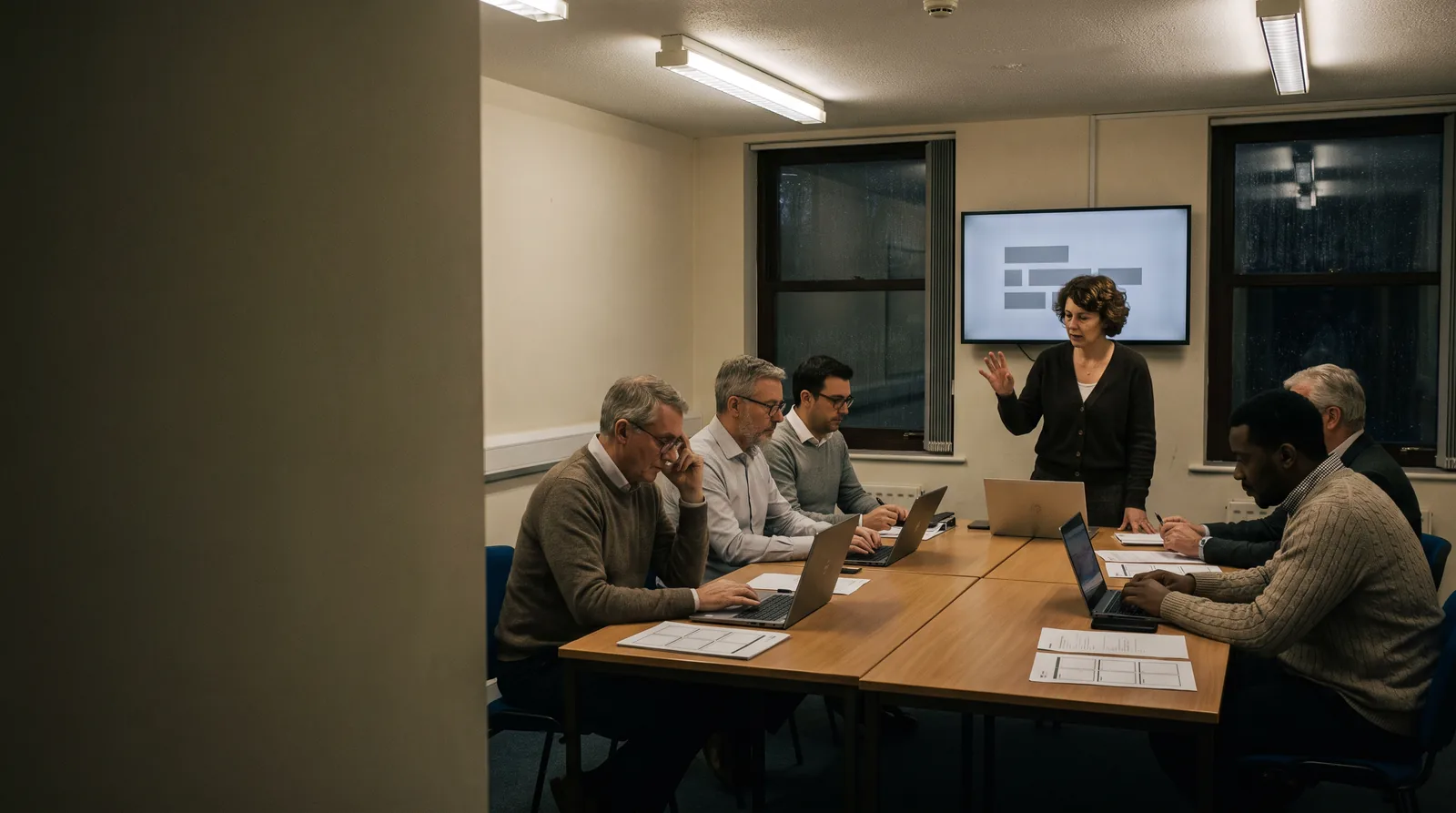
An evening staff training session in a plain British meeting room: adults at joined tables with laptops and printed handouts while a woman stands beside a screen mid-explanation.
Service 07 Services / Training & workshops

Training people can use on Monday morning

Digital skills training on the systems your team genuinely uses, online harms and digital safeguarding for the professionals who have to respond to it, and participatory workshops with young people. Written for your setting, delivered by the people who built the material, and left behind as resources you keep using.

The three strands, and what participants take away

■ 07.0 Staff session in progress — on the systems and cases the team actually has Staff skills · Online harms · Youth workshops
  • RegisteredLondon-based, registered in England and Wales
  • DeliverySenior-led — the people you brief do the work
  • DataUK GDPR and data protection by design
  • AccessibilityWCAG 2.2 AA as standard, not an extra
  • PricingA written scope before any quote
  • ContactDirect with the team, no account layer
01 The problemDiagnosis before build

Diagnosis first

Training that was attended, and changed nothing.

We do not quote until we understand what is actually going wrong. The first conversation is free, and it ends with a clear recommendation and a realistic figure — not a sales follow-up.

Everyone attended. Nobody does anything differently.

Generic slides, a room where half the equipment did not work, and a system that was replaced three months later anyway. The attendance register was the only thing the day actually produced.

It fails for predictable reasons. The content was written for a general audience rather than your setting. It was demonstrated on software your team does not have. It described the platform as it was two years ago. And nothing was left behind that anyone could open again in the moment they actually needed it.

Online harms training fails in a further, specific way: it lists dangers and stops. Staff leave able to name the risks — grooming, coercion, image-sharing, fraud, extremism, harassment, AI-generated content and manipulated media — and still without a script for the conversation, a threshold for escalation, or a view on what to do when the young person in front of them does not want anything reported. That gap is where the harm sits.

02 What we buildScope, in plain terms

The work itself

Three strands, built for your setting.

Written for your organisation, your systems and your cases. Enhanced DBS checks are in place for work involving young people, and sessions are delivered by the people who wrote the material.

01

Digital skills for staff

Training on the systems your team actually has in front of them — including anything we built for you. Practical, hands-on, and aimed at the tasks people do repeatedly rather than a tour of every feature.

  • Training on systems we have built for you
  • Microsoft 365 and everyday business tools
  • Documents, files and version control that holds
  • Data handling and UK GDPR in practice
  • Spreadsheet and reporting skills
  • Short written guides for the team to keep
02

Online harms & digital safeguarding

For teachers, youth workers, social workers, police, housing and frontline staff. What young people are actually experiencing online, how the mechanics work, and what a good response looks like — including the conversation and the escalation threshold.

  • How current platforms and features really work
  • Grooming, coercion and image-based abuse
  • Harassment, misogyny and radicalisation online
  • AI-generated and manipulated content, and the risks it creates for young people
  • Recognising, recording and escalating — with thresholds
  • Scripts and scenarios for the conversation itself
03

Workshops with young people

Participatory sessions rather than a lecture from the front: activities, scenarios and discussion that start from what young people are already dealing with. Designed to be reused by your own staff afterwards.

  • Digital safety and online harms sessions
  • Healthy relationships and respect online
  • Privacy, data and digital footprint
  • Creative and technology taster sessions
  • Co-design and consultation sessions
  • Age-appropriate, with your safeguarding lead involved
04

Co-design & consultation

Where you need young people or service users involved in a decision properly rather than nominally: structured sessions, honest facilitation, and a written record of what they actually said — including the inconvenient parts.

  • Structured consultation and co-design sessions
  • Facilitation that does not lead the answer
  • Accessible materials for every participant
  • Consent and safeguarding handled properly
  • Written findings, including the unwelcome ones
  • Feedback to participants on what changed
05

Materials you keep

Every session leaves behind resources your team can run again: facilitator notes, handouts, slides and quick-reference guides, designed properly rather than typed up afterwards.

  • Facilitator notes and session plans
  • Participant handouts and workbooks
  • Slides and quick-reference guides
  • Easy-read and youth-friendly versions
  • Editable files so you can update them
  • Designed, not just documented
06

Delivery, however suits you

In person at your site, online, or a mix. Single sessions, a programme across a term, or a train-the-trainer approach so your own staff can carry it on.

  • In person at your site, London and UK-wide
  • Online and hybrid delivery
  • Single sessions or a full programme
  • Train-the-trainer for internal delivery
  • INSET, twilight and evening slots
  • Group sizes that still allow participation
03 How it runsFive stages, five decisions

Stage by stage

You always know what happens next.

Every stage ends with something written and a decision that belongs to you. Nothing proceeds on an assumption we have not put in front of you.

  1. 01Scope the audienceWho is in the room, what they already know, what they will be expected to do differently afterwards.
  2. 02Build for your settingContent written around your systems, your policies and your cases — not a generic deck with your logo added.
  3. 03DeliverDelivered by the people who wrote it, at a group size that still allows people to ask real questions.
  4. 04Leave the materialsFacilitator notes, handouts and guides handed over in editable form so the session can run again without us.
  5. 05Follow upA short review of what landed and what needs reinforcing, and a route back for questions that surface later.

The full seven-stage delivery method, with the deliverable at each stage

04 What you getIn writing, and yours

Ownership

Yours to keep, and to take elsewhere.

Everything we make is handed over in full — the files, the code, the accounts, the documentation. Most clients stay with us because the working relationship earns it, not because anything is held back.

Session planObjectives, content and timing agreed in writing before the date.
MaterialsFacilitator notes, handouts and slides, designed and handed over in editable form.
Accessible versionsEasy-read and youth-friendly materials where participants need them.Our standards
SafeguardingEnhanced DBS in place for work with young people; your policies and lead respected throughout.Safeguarding
DataParticipant information handled under UK GDPR, minimally collected and not retained beyond need.How we handle data
Honest feedbackA written note of what worked and what your team still needs — not a satisfaction score.
05 Straight answersCost · Ownership · Risk

Before you email

The questions we get asked most.

Answered plainly, so you can rule us in or out without a meeting. If the answer you need is not here, ask — we will give you the same straight answer by email.

Q1 Is the online harms training current?

It is rewritten against what is actually happening on the platforms young people use, including AI-generated and manipulated content and the specific risks that creates for them. Content more than a few months old in this field is usually wrong in ways that matter, so we do not reuse a fixed deck.

Q2 Do you have DBS checks?

Yes. Enhanced DBS checks are in place for work involving young people, and we work within your safeguarding policy and alongside your designated lead rather than around them.

Q3 Can you train our staff on a system you built for us?

Yes, and it is included in the way we scope a build. Training on your own system, with your own data and your own edge cases, is far more effective than a generic course.

Q4 How large can a group be?

For hands-on digital skills, small enough that everyone gets helped — usually up to about twelve. For briefing-style safeguarding sessions, larger rooms work. For young people, small enough that quiet participants still speak. We will tell you if a proposed group size will undermine the session.

Q5 Do you deliver online?

Yes, and for some content it is better — short focused sessions close to when people need the knowledge. Hands-on work with young people and co-design sessions are almost always better in person.

Q6 What do we get afterwards?

The materials in editable form, so your own staff can run the session again. Train-the-trainer delivery is available where you want to build that capacity properly.

07Work with usWe reply within three working days

Bring us the problem.
We’ll build the solution.

Send a short outline of the work, your timeline and a budget range if you have one. We will come back with a written scope, an honest view of the risks, and a price.

hello@youngfuturesdigital.co.uk