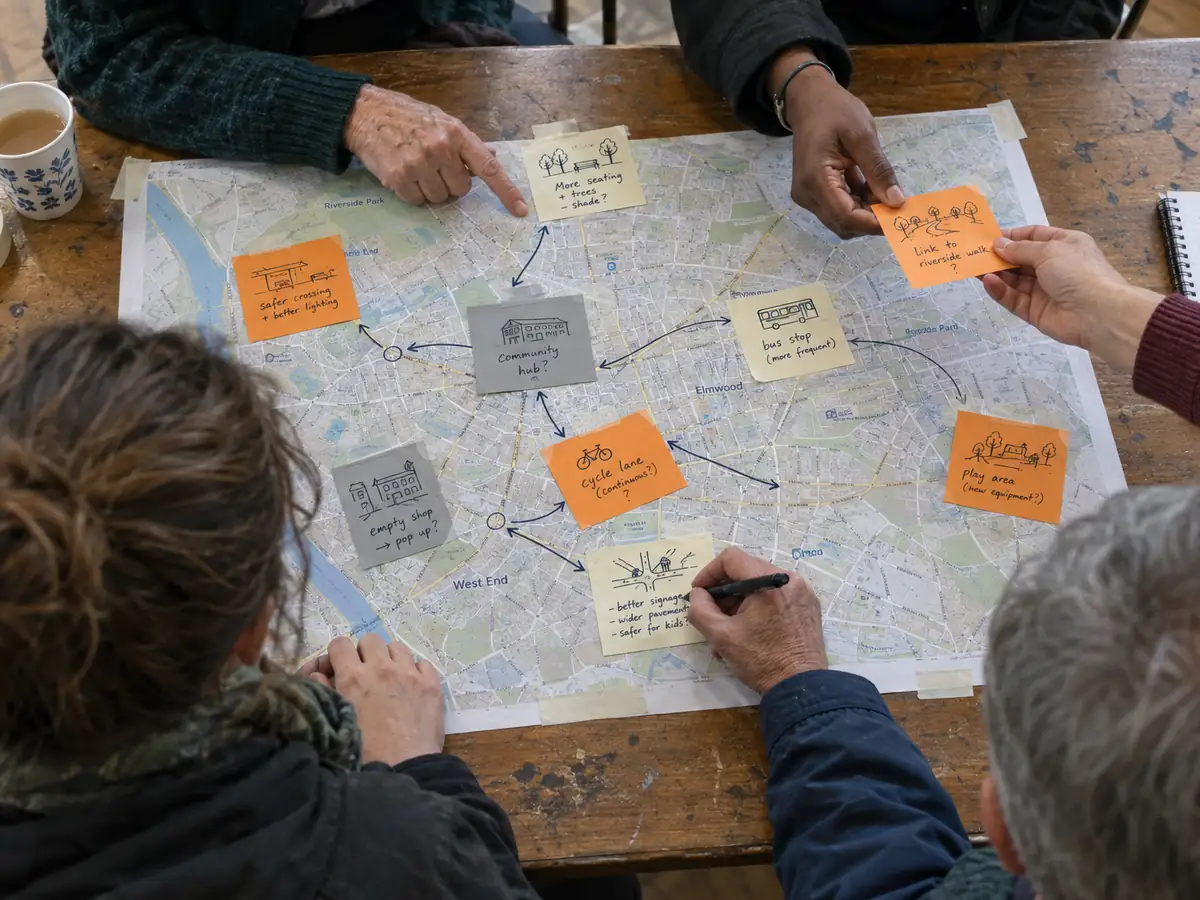
Councils, violence reduction units and safety partnerships plan with the data they have: recorded crime, ambulance call-outs, hospital admissions, antisocial behaviour logs, street-lighting faults. That data is valuable and it is also partial. Much of what makes a place feel unsafe, or actually be unsafe, never enters an official record. People do not report harassment on the way home. A dark alley that everyone avoids generates no incidents precisely because everyone avoids it. Young people rarely tell the police about the corner they walk the long way round.
Community-reported data promises to fill that gap. Done carelessly, it creates a new set of problems that look like evidence. This article sets out what we have learned from designing community reporting and what we would ask any commissioner to check before acting on it.
What community reports are good at
Community reports surface experience rather than events. They tell you where people feel exposed, what they avoid, which resources they know about and which they do not. They can be timely in a way that quarterly statistics cannot, and they can carry detail, such as a broken light or an unstaffed station entrance, that a crime record never would.
They are also a form of participation. Asking people what they are experiencing, and showing them what changed as a result, builds the trust that safety work depends on. A reporting system that never feeds anything back is an extraction exercise, not insight.
What they are bad at
Community reports are not a sample of anything. They come from the people who knew the system existed, had the confidence and the connectivity to use it and believed it might make a difference. Every one of those filters is unevenly distributed. Areas with active residents’ groups over-report. Areas where people distrust institutions under-report. Young people, disabled people and people without smartphones or data are missing in ways the dataset will not show you.
The most dangerous failure mode is reading absence as safety. A low-reporting estate is not a safe estate. A heatmap with a cold patch in the middle invites exactly that misreading, and a busy commissioner under time pressure will make it.
Reports can also be delayed, duplicated, exaggerated or malicious. Someone can report a group of teenagers as threatening because they are teenagers. If that report goes straight onto a map, the system has just laundered prejudice into data.
Five checks before you act on community data
- Is the source labelled? Official records, partner data, community reports and resource listings should never be blended into a single score. A practitioner should always be able to see which kind of information they are looking at.
- Can you see coverage? Show how many people in an area reported, not just how many reports there were. Where coverage is thin, say so on the same screen as the data.
- What is the verification status? Each report should carry whether it was moderated, corroborated by another source or left unverified. Unverified reports are still useful, as prompts for a conversation, not as facts.
- Who moderated it and how? There should be a written process for duplicate, malicious and discriminatory reports, applied by a person, before anything is published or acted on.
- Has anyone tested for bias? Compare reporting rates by ward, age band and, where you can, other characteristics. Publish the comparison alongside the data. If you cannot do this, treat the data as anecdote.
How to present it honestly
Every figure needs its source, age, geographic coverage, verification status and confidence beside it. Not in a methodology PDF, but on the same view. In our own work we treat this as a design requirement, and it changes how a dashboard looks: less colour, more text, fewer maps with confident boundaries.
Language matters too. “Seventeen residents reported feeling unsafe at this junction between June and August; no corroborating incident records” is honest. “Hotspot” is not. Community reports may be incomplete, delayed or unverified, and the presentation should say so every time.
Return the findings
People who contribute should hear what was found and what changed. A short, plain “you said, we changed” record, published where the reports were gathered, does more for future reporting than any feature. It also keeps the organisation honest: if nothing changed, that has to be written down too.
Where this leaves a commissioner
Community-reported data is worth having. It is worth having as one labelled source among several, governed before launch, presented with its limitations and returned to the people who provided it. It should inform conversations and prompt further inquiry. It should not, on its own, redirect patrols, close a park or label an area. Any supplier who tells you otherwise is selling you a map, not insight.
For our own principles in full, see ethical data and community insight. For the guardrails we apply to location-aware features, see how we work.
About this article. Written by the Young Futures Digital team from practitioner experience and published guidance. This is general guidance, not legal advice.